Its been quite some time since I wanted to read the author. Thanks to Arjun, that I got an e-book. (Thanks to my credit card, bought the book too the very next week).
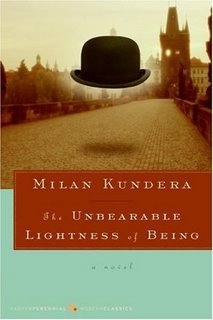
The story could have very well been one of those Mills & Boons fictions, revolving round a doctor and his wife, his mistress and her lover. It is with incredible ease that Kundera takes us through pages and pages of infidelity coupled with long narrations on his genre of philosophy.
Since history "never" repeats and we hardly get a chance to say if our actions were right or not as nothing occurs again for to compare, the author doesn't give any absolute sense of right or wrong. Not even when he scorns at the Soviet Invasion of Czech and Czech communists. Though the doctor loses his profession that was his passion, in the end he is a happy man being a mere truck driver. His wife, who was always jealous about his mistresses, finally learns to separate love from physical intimacy.
Kundera's own loss of freedom of expression might have affected this novel, yet there is an underlying lack of trust or discomfort the painter mistress in the story goes through in America. Though she enjoys the freedom, she is equally disturbed of being buried in that alien land. She wants to fly free even after her death.
The entire novel can be viewed as an individualistic view on the communist régime – it is with amazing dexterity that Kundera avoids any political opinion in this regard. It is only the loss of individual freedom that matters, that again doesn’t really go with the freedom struggle we understand.
Nietzsche's doctrine of the eternal recurrence is what the novel starts with and Mozart is a leitmotif. I understand how well and easily Nietzsche fits in, but what amazes me is how incredibly well the author brings up Mozart. Then again, it is a review on Oedipus that is the centre theme of the whole book.
I can't say this is purely fiction; I would rather call it an explanation of his philosophy.
Labels: books